
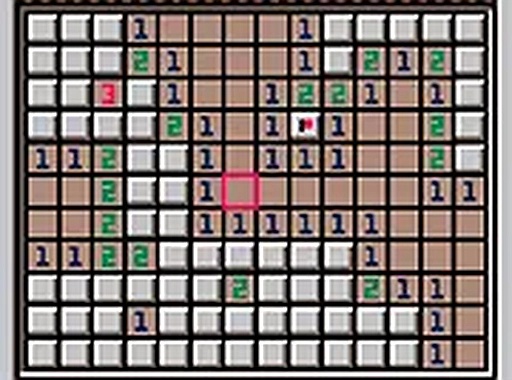
The Core Logic Mechanic
At its heart, Grid Deduction Challenge is about using limited information to make safe decisions. The playing field consists of a grid of covered squares. When you reveal a square, a number appears. This number tells you exactly how many of the squares directly adjacent (horizontally, vertically, or diagonally) contain a hidden trap. By carefully tracking these numbers, you can deduce which squares are safe to click and which ones you should avoid. It is a pure exercise in deductive reasoning, rewarding careful thought over speed.
Visual Style and Atmosphere
The game adopts a pixelated art style that intentionally echoes the look of early computer and arcade games. This aesthetic choice is not just for nostalgia; it keeps the interface clean and uncluttered, allowing you to focus entirely on the puzzle. The color palette is simple, with distinct visual cues for revealed tiles, markers, and traps. The overall presentation is minimal, ensuring that the gameplay remains the central focus without unnecessary distractions.
Controls and Accessibility
Grid Deduction Challenge is designed for straightforward interaction. On a desktop computer, you use the left mouse button to reveal a tile and the right mouse button to place a marker on a tile you suspect holds a trap. On touch-enabled devices, a simple tap reveals a tile, while a long press places a marker. This simple control scheme makes the game immediately accessible to new players, while the increasing complexity of larger grids provides a satisfying challenge for experienced puzzle enthusiasts.
Progression and Difficulty
The game likely offers a range of grid sizes, from small, beginner-friendly layouts to much larger and more complex ones. Starting with a smaller grid helps you learn the basic deduction process. As you move to larger grids, the number of tiles and traps increases, requiring more careful planning and advanced logical reasoning. This natural progression ensures that the game remains engaging and offers a consistent mental challenge as your skills improve.
Strategic Thinking and Patience
Success in Grid Deduction Challenge comes from a combination of careful observation and patience. Rushing through a puzzle often leads to mistakes. A better approach is to take your time, analyze each clue, and only make a move when you are reasonably certain of the outcome. Using the marker feature to track suspected trap locations is a key strategy, but it is important to only mark tiles based on solid evidence from the numeric clues. Regular play helps sharpen pattern recognition and logical deduction skills over time.
COMMENTS
0 comments